
Planning an Event That Makes Headlines: How to Plan a Press Event Journalists Want to Attend
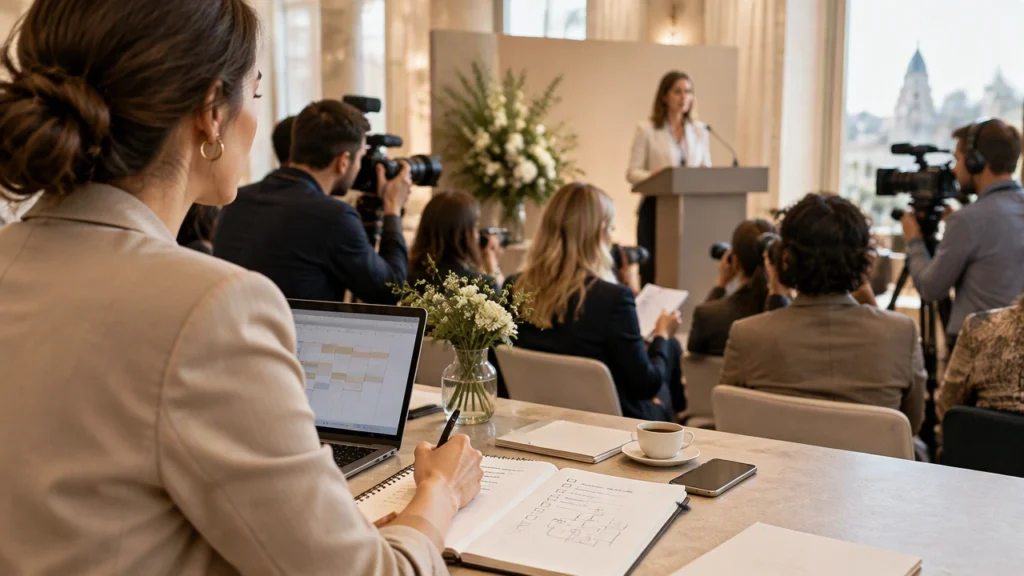
Public relations is, at its core, about moving a message from your organization into the conversations people trust. One of the most direct ways that happens is through a well-planned press event. Reporters, producers, and editors decide every day which stories to cover, and they choose events that are easy to understand, easy to photograph, and easy to turn into a clear story. If you want to learn how to plan a press event journalists want to attend, focus on three fundamentals: a strong hook, accessible spokespeople, and a simple photo moment.
Start with a strong hook
A hook is the reason the event exists today and not next week. It should answer the question a journalist asks first: why now? Without a timely angle, even a well-organized event can feel like a private celebration rather than a public story.
- Make it timely. Tie the event to a milestone, a public report, a policy change, a seasonal trend, or a verified local need. A new transit line opening, a safety audit release, or a community health initiative launch all create a clear reason to gather.
- Make it specific. Replace vague goals with a single, concrete announcement. Instead of “celebrating progress,” try “releasing the first year results of a job training program with 200 graduates.”
- Make it relevant. Connect the hook to the audience a reporter serves. Local outlets care about local impact. Trade outlets care about industry significance. National outlets look for broader implications backed by evidence.
- Make it provable. Offer data, a demonstration, or a first-hand account that a reporter can verify. Strong hooks stand up to follow-up questions.
A simple way to test your hook is to finish this sentence in one line: “Today we are announcing ___ because ___.” If you cannot complete it clearly, refine until you can. The tighter the hook, the easier it is for a journalist to see the story.
Build a story around the hook, not the other way around
Once you have a hook, shape the event around it. Every choice, from the invite list to the agenda, should support the story you want reporters to tell.
- Define the headline you hope to earn. Write one sentence that captures the story. Use it internally to guide decisions.
- Choose a format that matches the message. A short announcement with a demonstration often works better than a long ceremony. A walking tour can be more visual than a panel. A live Q&A can be more transparent than a scripted speech.
- Keep the agenda tight. Journalists appreciate events that respect their time. A 30 to 45 minute program with clear segments is easier to cover than a two-hour block with repeated acknowledgments.
- Plan for multiple media formats. Offer a clear soundbite, a visual moment, and a written release. This helps print, online, TV, and radio reporters all find what they need.
Select accessible spokespeople
A spokesperson is the human face of your message. Accessibility means they are available, understandable, and prepared to speak in plain language about the topic.
- Choose people who can explain, not just announce. A program director who can describe how a service works often provides stronger quotes than a title-heavy speaker who only reads a statement.
- Offer media training. Help spokespeople practice short answers, bridge to key points, and avoid jargon. Encourage them to use concrete examples and numbers that are easy to remember.
- Make them available before and after the event. Reporters may need a quick pre-brief or a short one-on-one. Set aside 15 minutes on each side of the program for brief interviews.
- Provide a media contact who responds fast. A real person who replies within an hour builds trust and keeps your event in the running as deadlines approach.
Accessibility also includes language access. If your community speaks multiple languages, provide translated materials or interpreters. This widens your reach and shows respect for the audience the reporter serves.
Create a simple photo moment
Images help stories travel. A clear, easy-to-photograph moment increases the chance that your event gets visual coverage online, in print, or on air.
- Design one visual centerpiece. A ribbon cutting, a product demonstration, a map reveal, or a short walk-through can be enough. Keep it clean and uncluttered.
- Control the background. Remove distracting signs, test lighting, and make sure branding is visible but not overwhelming. Simple backgrounds produce stronger photos.
- Plan the timing. Schedule the photo moment early, when energy is high and the room is not yet crowded. Give photographers a clear line of sight.
- Assign a staff “visual guide.” This person helps reporters find the best angle, answers quick questions, and keeps the area clear during the key moment.
If your story is data-driven, create a large, readable chart or map that can serve as a backdrop. If your story is human-centered, focus on a moment that shows the work in action rather than a line of people shaking hands.
Make logistics effortless for the press
Even the best story can be derailed by practical barriers. Reduce friction and you increase the likelihood of coverage.
- Send a concise advisory. Include date, time, location, parking or transit details, the hook in one sentence, and a media contact with a phone number. Keep it under 200 words.
- Offer a press kit. Provide a one-page release, key facts, quotes, high-resolution images, and any data tables. Host it online with a simple link and a short password if needed.
- Choose an accessible venue. Consider proximity to public transit, wheelchair access, and clear signage. A location that is easy to find is easier to cover.
- Provide reliable Wi-Fi and a quiet corner. Reporters often file from the event. A small workspace with power outlets can be the difference between same-day coverage and a missed deadline.
Follow up with precision
Your work does not end when the event does. Thoughtful follow-up keeps your story alive and helps reporters who could not attend.
- Send a brief recap within two hours. Include the headline you hoped to earn, one or two key facts, a quote, and a link to images or video.
- Offer a second interview. If new data or a new angle emerges, invite reporters to speak with a subject-matter expert.
- Share outcomes. If the event leads to a policy change, a funding commitment, or a measurable result, send a short update. This builds credibility for the next pitch.
A simple planning checklist
- Hook: one sentence that explains why now
- Headline: the story you hope to earn
- Agenda: 30 to 45 minutes with clear segments
- Spokespeople: two to three trained, available, and briefed
- Photo moment: one visual centerpiece with good lighting
- Press kit: release, facts, quotes, images, data link
- Logistics: venue, Wi-Fi, directions, parking, media contact
- Follow-up: recap, extra interviews, outcome updates
When you learn how to plan a press event journalists want to attend, you are really learning how to make it easy for a reporter to tell a clear, honest story. A strong hook gives the event urgency. Accessible spokespeople give the story humanity. A simple photo moment gives the piece a visual anchor. Combine these elements with thoughtful logistics and precise follow-up, and your message has a far better chance of moving from your organization into the public conversation in a way that is accurate, useful, and lasting.